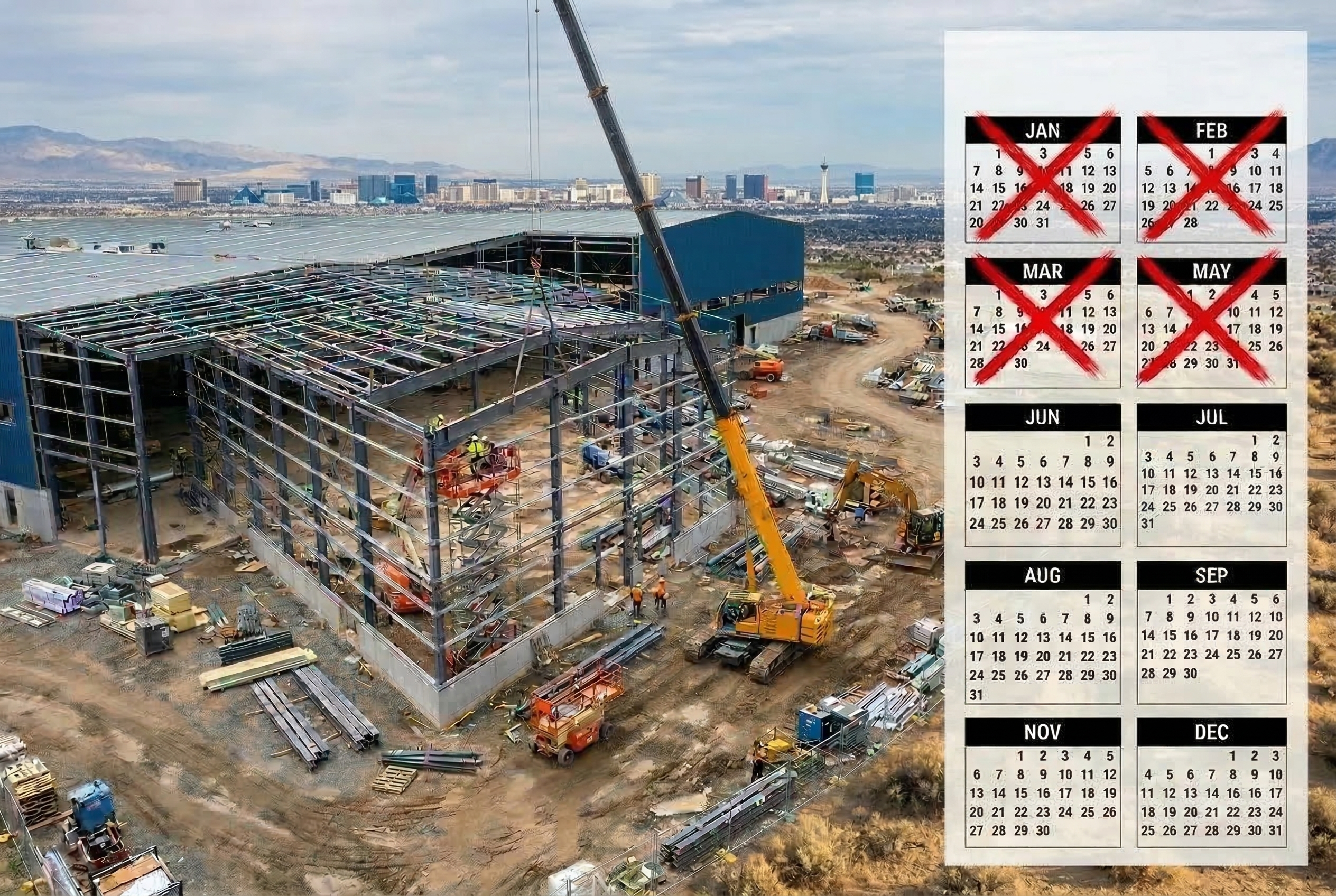
Resolving Construction Delay Disputes Without Litigation
Construction delay disputes are among the most technically demanding and financially consequential conflicts in the industry. Whether a project has stalled over schedule slippage, competing delay claims, or liquidated damages, the parties involved face mounting costs with every day the dispute remains unresolved.
Noah Allison brings decades of front line construction litigation experience, a sitting role as an Administrative Law Judge with the Nevada State Contractors Board, and a direct, results-driven approach to helping contractors, property owners, and their counsel resolve delay and schedule disputes efficiently — before runaway litigation costs exceed the value of the claim itself.
“This is the only time you actually get to decide how the case gets resolved. Once you’re in court or arbitration, someone else will make that decision for you.” — Noah Allison
Why Delay Disputes Demand a Specialized Neutral
Delay claims rarely come down to a single missed deadline. They involve overlapping timelines, shifting responsibility, and technical evidence that general-practice mediators and arbitrators are often ill-equipped to evaluate. A neutral who lacks construction scheduling fluency can slow proceedings, misunderstand the evidence, or push the parties toward an outcome that doesn’t reflect the facts.
Noah’s background sets him apart. He decades of experience with all of the legal aspects of Nevada construction. He understands CPM scheduling methodology, float consumption, concurrent delay analysis, and how these technical concepts translate into real-world liability. When parties present competing schedule narratives, Noah has the experience to identify where the truth lies — and to help both sides see it clearly.
Common Types of Delay Disputes We Handle
Owner-Caused Delays
Late approvals, design changes, failure to provide site access, or slow responses to submittals and RFIs can push a project weeks or months behind schedule. Contractors facing these delays often have legitimate time extension and cost recovery claims — but proving them requires careful documentation and a neutral who understands the standard of proof.
Contractor and Subcontractor Performance Delays
Owners and general contractors dealing with underperforming trade partners face the challenge of establishing that a specific party’s performance — not other project conditions — caused the delay. These disputes frequently involve competing narratives about resource loading, sequencing, and whether adequate manpower was deployed.
Concurrent Delay
When multiple parties contribute to the same period of delay, determining responsibility becomes exceptionally complex. Concurrent delay analysis requires a neutral who can parse overlapping schedule impacts and allocate responsibility fairly, rather than defaulting to a split-the-difference result that satisfies no one.
Weather and Force Majeure Claims
Disputes over excusable versus compensable delay frequently arise when abnormal weather, supply chain disruptions, or unforeseen site conditions affect the project timeline. These claims require an understanding of baseline schedule assumptions and how to measure actual impact against contractual entitlements.
Liquidated Damages and Schedule Acceleration
When an owner withholds liquidated damages or a contractor claims it was forced to accelerate to meet an unreasonable schedule, the financial stakes escalate quickly. Resolving these disputes requires a neutral who can evaluate whether the original schedule was achievable, whether acceleration was actually directed or constructive, and whether damages are proportionate.
Mediation vs. Arbitration for Delay Disputes
Understanding the difference between these two paths is critical to choosing the right approach for your situation.
Mediation: You Stay in Control
In mediation, Noah works with both parties in separate, confidential sessions to identify the real obstacles to resolution. He reviews scheduling evidence, evaluates each side’s strengths and weaknesses candidly, and moves the parties toward a range where settlement is possible. Nothing is imposed. The parties retain full decision-making authority over the outcome.
Noah’s mediation process for delay disputes typically includes a pre-mediation conference call with counsel, a structured briefing schedule so he can review schedule analyses and supporting documentation in advance, and pre-session calls with each side to signal his preliminary observations. This preparation means the mediation session itself starts with momentum rather than orientation.
Arbitration: An Expert Decision-Maker
When the parties cannot reach agreement on their own — or when the dispute requires a binding decision — Noah serves as a private arbitrator with the construction expertise to evaluate technical evidence efficiently. His proceedings are less formal than court but no less rigorous. He asks probing questions, cuts off irrelevant testimony, and moves decisively through the evidence.
As Noah describes his approach: he won’t be bound by rigid courtroom evidentiary rules, but he also won’t waste time. If something is irrelevant, he’ll stop it. His arbitration awards are grounded in the facts and the law — not in splitting the difference.
At a Glance
| Mediation | Arbitration | |
|---|---|---|
| Outcome | Voluntary settlement agreed to by both parties | Binding decision issued by the arbitrator |
| Party Control | Full — parties decide the result | Limited — arbitrator decides based on evidence and law |
| Formality | Informal, confidential sessions | Structured hearings, less formal than court |
| Schedule Evidence | Reviewed and discussed to drive settlement | Presented as testimony and exhibits for ruling |
| Best For | Parties who want to control the outcome and preserve relationships | Disputes requiring a final, enforceable decision |
| Timeline | Typically resolved in a single session | Weeks to months depending on complexity |
Special Master Services for Complex Schedule Disputes
In large-scale construction litigation, Nevada district courts may appoint a Special Master to handle specific evidentiary or procedural components of a case. Noah is available to serve in this capacity, particularly for schedule and delay disputes where the court would benefit from a neutral with deep construction expertise.
As a Special Master, Noah can conduct focused hearings on delay and scheduling issues, evaluate competing schedule analyses and expert reports, prepare findings and recommendations for the court, and manage discovery disputes related to scheduling data and project records. Parties and counsel seeking to recommend a Special Master to the court for a construction delay matter are encouraged to reach out directly.
Who We Work With
Noah’s delay and schedule dispute resolution services are available to general contractors and specialty subcontractors facing or defending delay claims, property owners and developers dealing with schedule overruns and cost exposure, construction attorneys seeking an experienced and efficient neutral for mediation or arbitration, and parties in active litigation looking to recommend a Special Master to the court.
The size of the dispute does not determine whether it’s a good fit. What matters is whether the parties are serious about resolving the conflict. Some of the most entrenched disputes involve modest dollar amounts but deeply held positions — and those cases benefit from a skilled neutral just as much as the large ones.
Why Resolve a Delay Dispute Now
Delay disputes compound. The longer they persist, the more they cost — not just in legal fees, but in project carrying costs, damaged business relationships, and the organizational distraction of ongoing litigation. Mediation and arbitration offer a faster, more cost-effective path to resolution, with the added benefit of keeping the details of the dispute out of the public record.
In courtroom litigation, parties surrender control over both the timeline and the outcome. A judge assigned to a construction delay case may have no scheduling expertise. A jury will almost certainly have none. The result is unpredictable regardless of the merits. Mediation and arbitration with a construction-experienced neutral restore both efficiency and predictability to the process.
Request a Consultation
If you are facing a construction delay dispute in Nevada and want to explore mediation, arbitration, or Special Master services, contact Allison Mediation & Arbitration to schedule an initial consultation.
The information provided on this page is for general informational purposes only and does not constitute legal advice or counsel. No professional-client relationship is formed by accessing this content or contacting Allison Mediation & Arbitration. Please do not share privileged or confidential information through website forms prior to a formal engagement.